
PM Sanae Takaichi's Annoucement on Immigration Policy

Source: Prime Minister Sanae Takaichi's official Facebook post, dated September 27, 2026.
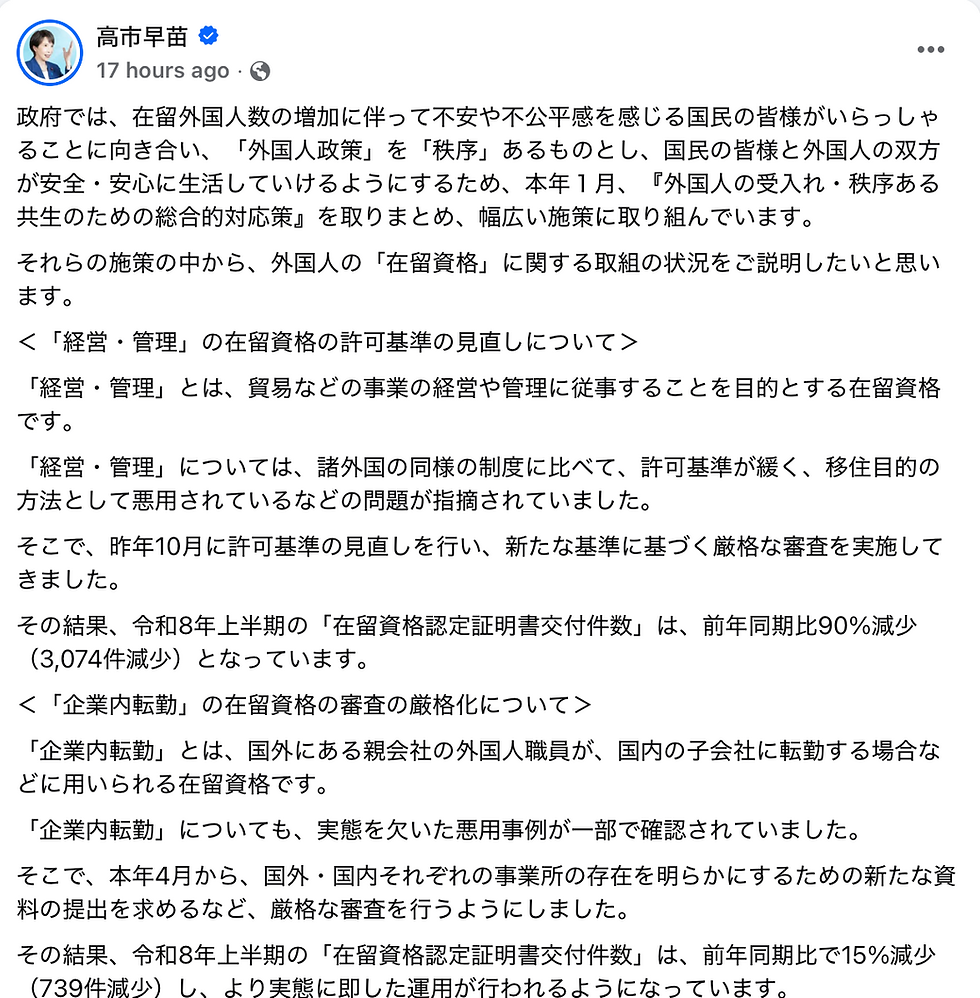
The government is facing up to the anxiety and sense of unfairness that some members of the public feel as the number of foreign residents in Japan increases. To bring "order" to our foreign national policy and enable both Japanese citizens and foreign nationals to live safely and with peace of mind, we compiled the Comprehensive Response Package for the Acceptance of Foreign Nationals and Orderly Coexistence this past January, and we have been working on a wide range of measures under it.
Among these measures, I would like to explain where things stand on our work regarding foreign nationals' "status of residence."
On the review of the approval criteria for the "Business Manager" status of residence
"Business Manager" is a status of residence for those engaged in the management or administration of a business, such as trading operations.
It had been pointed out that, compared with similar systems in other countries, the approval criteria for "Business Manager" were too lenient, and that the status was being abused as a means of immigration.
In response, we revised the approval criteria last October and have since carried out strict screening under the new standards.
As a result, the number of "Certificates of Eligibility" issued in the first half of Reiwa 8 (2026) fell by 90% year-on-year (a decrease of 3,074 cases).
On stricter screening for the "Intra-company Transferee" status of residence
"Intra-company Transferee" is a status of residence used, for example, when a foreign employee of an overseas parent company is transferred to that company's subsidiary in Japan.
For "Intra-company Transferee" as well, we had confirmed some cases of abuse involving arrangements that lacked real substance.
In response, starting this past April, we began requiring the submission of new documentation to clarify the existence of both the overseas and domestic offices involved, among other measures, in order to conduct stricter screening.
As a result, the number of "Certificates of Eligibility" issued in the first half of Reiwa 8 (2026) fell by 15% year-on-year (a decrease of 739 cases), and operations are now being conducted in a manner that more accurately reflects actual conditions.
On stricter screening for the "Engineer/Specialist in Humanities/International Services" status of residence
"Engineer/Specialist in Humanities/International Services" is a status of residence used by those employed by Japanese companies and other organizations who apply technical or specialized knowledge in the natural or human sciences, or foreign language ability, in their work. It is used across a wide range of fields, including systems engineers, accounting and finance staff, and interpreters and language teachers.
It has been pointed out that, for this status as well, there are occasional cases of individuals engaging in activities that do not correspond to the status of residence they hold.
As a countermeasure, we are working to strengthen screening — for example, by requiring both the dispatching and host workplaces to submit written pledges regarding the duties the individual will perform, and by confirming language proficiency (confirming a proficiency level equivalent to CEFR B2).
This past July, we decided to urgently add 226 staff, including immigration inspectors at the Immigration Services Agency, and we will further accelerate these efforts.
On making the "Permanent Residency" system more appropriate
"Permanent Resident" is a status of residence created as the most stable legal status, with no restrictions on activities or period of stay, and therefore requires especially careful screening.
Reflecting this position, we have decided to revise the Guidelines on Permission for Permanent Residency.
The revision has two main points.
To obtain "Permanent Resident" status, an applicant must satisfy the "independent livelihood requirement" — that is, possess sufficient assets or skills to maintain an independent livelihood. In practice, however, there have been many cases of individuals who obtained "Permanent Resident" status despite being unable to maintain an independent livelihood.
In response, regarding the "independent livelihood requirement," we plan to:
Revise the household income standard to "a level exceeding the average household income of Japanese households," and
Newly take into account projected future pension amounts.
In addition, regarding the so-called "national interest requirement" — that is, that the person's permanent residency is recognized as being in Japan's national interest — we also plan to newly take into account matters such as:
Whether the applicant possesses a certain level of Japanese language proficiency, and
Whether the applicant's understanding of Japan's systems and rules has reached a certain level.
The new guidelines are scheduled to be revised on October 1, after consideration of the opinions received through the public comment process.
Comments