
Japanese Attitudes Toward Foreign Workers Have Hardened Sharply, Stanford Survey Finds

Based on reporting by Noriko Akiyama, Asahi Shimbun GLOBE+, published April 3, 2026, part of the series "When 'Immigration' Becomes a Political Flashpoint" (source)
Japanese public opinion on accepting foreign workers has grown markedly more cautious over the past few years, according to a new Stanford University survey — and researchers say the shift traces back to a specific political trigger, not a slow cultural drift.
The findings come from Japan Barometer, an ongoing online opinion survey on Japanese society, the economy, and politics, run by Kiyoteru Tsutsui, a sociology professor at Stanford and director of the university's Center for Asia-Pacific Research, together with Charles Crabtree, an associate professor at Monash University in Australia. It's one of the largest surveys of its kind conducted in Japan, and this round focused specifically on immigration and foreign residents.
Opposition jumped 18 points in four years
The survey was fielded in two waves timed around February 2026's Lower House election (voting took place February 8): once from February 6–8, just before the vote, and again from February 13–16, just after. Each wave drew roughly 4,000 respondents, and the results were nearly identical before and after the election.
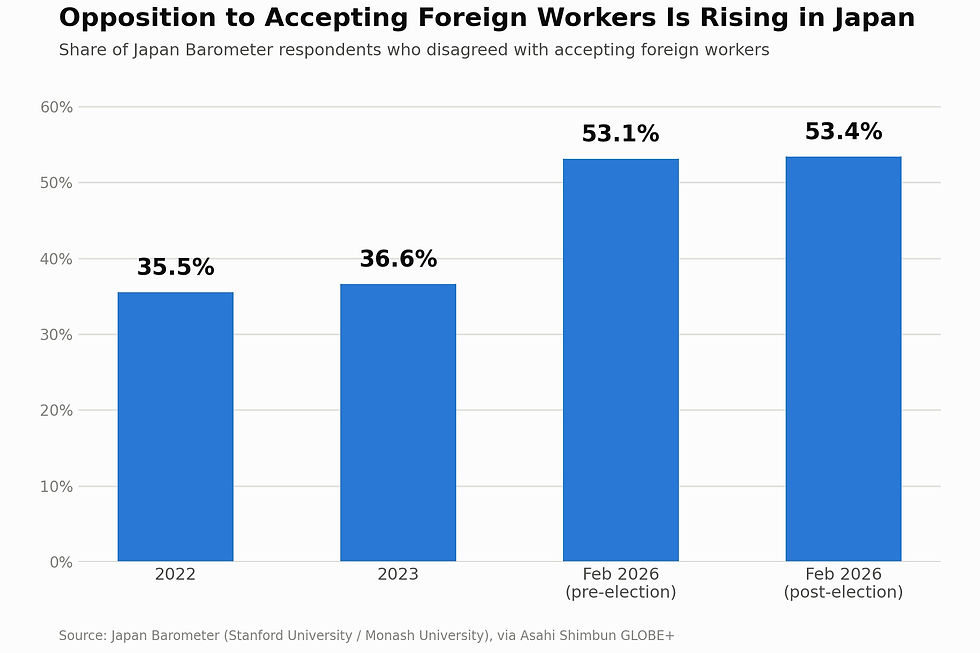
Respondents were asked how strongly they agreed or disagreed with 16 policy priorities, from climate change and Japan's falling birthrate to AI strategy and disaster preparedness. On "accepting foreign workers," 46.9% of respondents in the first wave said they agreed (combining "agree" and "somewhat agree"), while 53.1% disagreed — the highest opposition rate of all 16 issues polled. The second wave produced nearly the same split: 46.6% agree, 53.4% disagree.
For comparison, Japan Barometer asked similar questions in 2022 and 2023, when opposition to accepting foreign workers stood at 35.5% and 36.6% respectively. That means opposition rose roughly 18 percentage points between 2022 and 2026 — a far bigger swing than any other policy area in the survey, most of which saw opposition hold steady or even decline slightly over the same period.
Who Japanese respondents say they'd welcome
The survey also used a conjoint experiment — asking respondents to play the role of an immigration officer choosing between two hypothetical applicants — to figure out which immigrant traits Japanese people actually favor. Each hypothetical applicant varied randomly across nine attributes: gender, education, country of origin, Japanese-language ability, reason for applying, occupation, years of work experience, employment plans in Japan, and prior travel history to Japan. Respondents made this forced choice six times, which lets researchers statistically isolate real preferences rather than surface-level answers.
The most favored profile overall: a woman with a graduate degree, fluent Japanese, applying to reunite with family already in Japan, working as a doctor, with five or more years of experience, an existing job contract in Japan, and a prior six-month stay in the country with family.
By country of origin, the ranking of preference ran: Germany, then the United States, India, Vietnam, Turkey, Brazil, South Korea, and — least preferred — China.
What moves opinion, and why China ranks lowest
A separate part of the survey tested how framing shapes support for immigration. Respondents read one of several short statements — that increased immigration would benefit or burden Japan's economy, enrich or damage Japanese culture, or bring stability or disorder to governance and public safety — before being asked whether they'd support expanding immigration. Framing immigration as an economic benefit produced the single largest jump in support; framing it as a threat to governance and public safety produced the largest jump in opposition.
Professor Tsutsui attributes the overall hardening in attitudes to politics rather than economics. "Accepting foreign workers has become a major concern for Japanese people. It probably wasn't that important an issue for the average person before, but interest has risen rapidly since the 2025 Upper House election and the gubernatorial elections that followed — this looks like the effect of political mobilization by parties such as Sanseito," he said. "Japan's share of foreign residents, while rising, is still low compared with Western countries. It was striking that public opinion shifted this much through political campaigning even in a country that hasn't actually taken in that many immigrants."
On why Chinese applicants ranked lowest, Tsutsui pointed to a broader pattern: "There's a fairly universal tendency to dislike minority groups seen as becoming competitors who threaten one's own status — the same dynamic seen in the U.S. after the civil rights era, when white Americans reacted to Black Americans moving into their neighborhoods and schools. For Japanese people, Vietnamese workers, even though they're also Asian, tend to be seen as filling labor shortages in fields like caregiving — playing a complementary role rather than a competitive one. That's a sharp contrast with how Chinese people are perceived."
He added that the immigrants Japanese respondents find easiest to accept share a common profile: highly educated, experienced, fluent in Japanese, and clearly positioned to contribute to Japanese society. "The same pattern shows up in U.S. surveys — competence is what gets rewarded."
Japan Barometer's full survey data is available at japanbarometer.org.
Comments