
What's Actually Driving Japan's Harder Line on Foreign Residents? A Waseda Survey Points to Social Media and Politics

Based on reporting from the Global Research Center (GRC), Waseda University, "Analysis of Changes in Japanese Society's Attitudes Toward Foreigners and Political Consciousness," published May 25, 2026 (source)
Note: this post overlaps a little with an earlier piece on the Stanford Japan Barometer survey — both are tracking the same underlying shift in Japanese public opinion. This one digs into a different question: not just that attitudes have hardened, but what seems to be driving it.
A new survey out of Waseda University's Global Research Center adds another data point to a trend we've now seen from more than one source: Japanese public concern about foreign residents has risen sharply, and it's risen fastest among people who get their political information from social media, and among younger voters who lean politically right.
The survey, led by Professor Toshisuke Tanabe of Waseda's Faculty of Letters, is the fifth installment of a poll the university has run every four years since 2009. Questionnaires went out to 9,000 randomly selected voters (aged 18–79) drawn from electoral rolls across 45 cities, wards, and towns nationwide; 3,009 people responded, a 34.5% response rate. Fieldwork ran from November to December 2025 — the same window covered by the Stanford Japan Barometer survey discussed in the earlier post.
Public order concern hit 73% — and social media users are far more worried
Asked whether an increase in foreign residents would disrupt Japan's public order and safety, 73% of respondents in the 2025 survey agreed — a level notably higher than in the 2021 and 2024 rounds of the same survey.
The gap by information source stands out. Among respondents who regularly get political and social information from social media, 84% agreed (combining "agree" and "somewhat agree") that rising foreign resident numbers threaten public order. Among those who rarely use social media for that purpose, the figure was 67% — still a majority, but 17 points lower.
Americans welcome, China much less so — echoing the Stanford findings
The Waseda survey also asked about support for increasing immigration from specific countries, and the pattern lines up closely with what Stanford's Japan Barometer found in its conjoint experiment: 55% of respondents supported an increase in American residents, while support for an increase in Chinese residents fell below 10%. That's a steep drop from 2009, when 31% supported more Chinese immigration — a 21-point decline over 16 years.
Two independently designed surveys, using different methodologies, are converging on the same basic finding: Japanese public opinion isn't simply "pro-" or "anti-immigration" — it varies sharply by the immigrant's country of origin, and China consistently ranks at the bottom.
Younger, more online, more supportive of the political right
The generational pattern here is worth sitting with. Prime Minister Sanae Takaichi drew majority "like" ratings across every age group in the survey, but the effect was strongest among the young: about 79% of respondents in their 20s and 30s said they liked her, a notably higher rate than older cohorts.
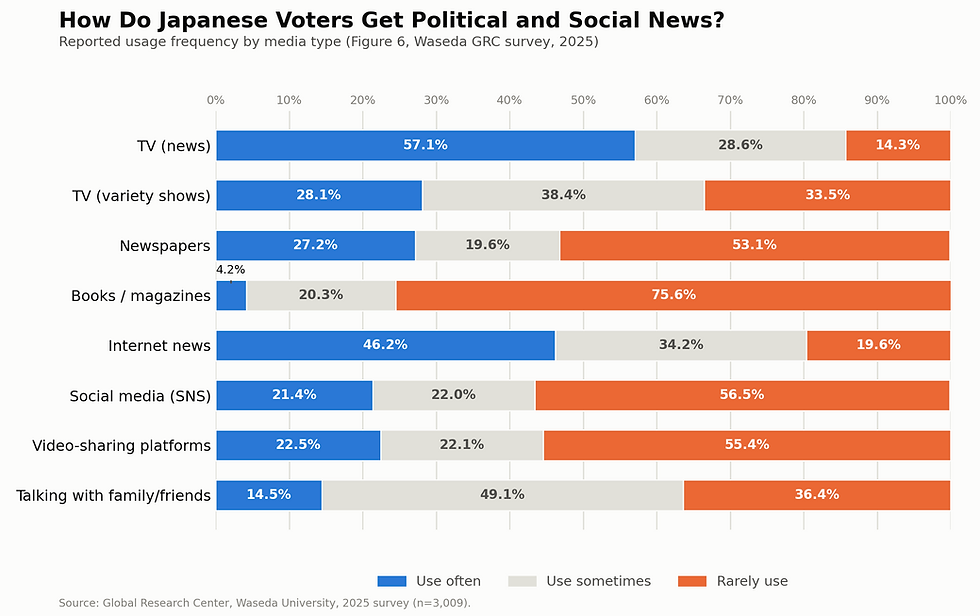
Overall, television news (57.1%) and internet news (46.2%) remained the dominant sources of political information for the sample as a whole, with social media at just 21.4%. But that overall figure masks a generational split: among respondents 34 and under, 55% said they frequently use social media for political and social information — more than double the general population's rate.
Put together, the picture the Waseda data paints is a younger, more online cohort that is simultaneously more favorable toward Japan's current right-leaning political leadership and more worried about foreign residents — with social media use itself tracking closely with that worry.

Why this matters alongside the Stanford findings
Neither survey can fully explain the other, but they tell a consistent story. The Stanford Japan Barometer piece we covered earlier found that opposition to accepting foreign workers jumped from roughly 36% to over 53% between 2023 and 2026, and that Stanford's Kiyoteru Tsutsui attributed the shift to political mobilization following Japan's 2025 elections rather than any large underlying demographic change. The Waseda survey gives that theory some empirical backing from a different angle: the people driving the sharpest rise in concern are disproportionately those consuming political content through social media and those most favorably disposed toward the political right — exactly the combination you'd expect if political messaging, rather than lived experience with a larger foreign-born population, were doing most of the work.
Professor Tanabe frames the broader project this way: through repeated survey observation over time, the research aims to track how social changes shape public opinion, and to map the mechanisms behind those shifts. On that front, this round of data gives a fairly clear signal about where to look next.
Survey data: Global Research Center, Waseda University.
Comments