
78% of Japanese Companies Employ No Foreign Workers at All — But the Ones Who Do Say They Can't Do Without Them

Based on reporting from Tokyo Shoko Research, "外国人労働者 企業の78.2%が雇用ゼロ 中小企業は製造業、建設業などで不可欠に" ("Foreign Workers: 78.2% of Companies Have Zero Employment; SMEs Call Them Indispensable in Manufacturing, Construction"), published August 19, 2025 (source)
A new survey from Tokyo Shoko (Tokyo Chamber of Commerce) Research puts a number on something that's easy to lose sight of in the debate over Japan's tightening immigration rules: most Japanese companies don't employ any foreign workers at all — but the minority that do are increasingly dependent on them, especially in a handful of hands-on industries.
Zero employment is the norm, especially for smaller firms
Tokyo Shoko Research surveyed 6,459 companies nationwide by online questionnaire in August 2025, defining a "foreign worker" as a full-time, directly employed staff member who does not hold Japanese citizenship (excluding contract and dispatch workers). The headline finding: 78.2% of respondents — 5,056 of 6,459 companies — employ zero such workers.
That figure breaks down unevenly by company size. Among small and medium-sized enterprises, 79.1% (4,714 of 5,958) have no foreign employees, versus 68.2% (342 of 501) among large enterprises — a 10.9-point gap. In other words, foreign labor in Japan is disproportionately concentrated in bigger companies, even though SMEs make up the overwhelming majority of the survey sample.
Where foreign workers actually matter: manufacturing, agriculture, construction
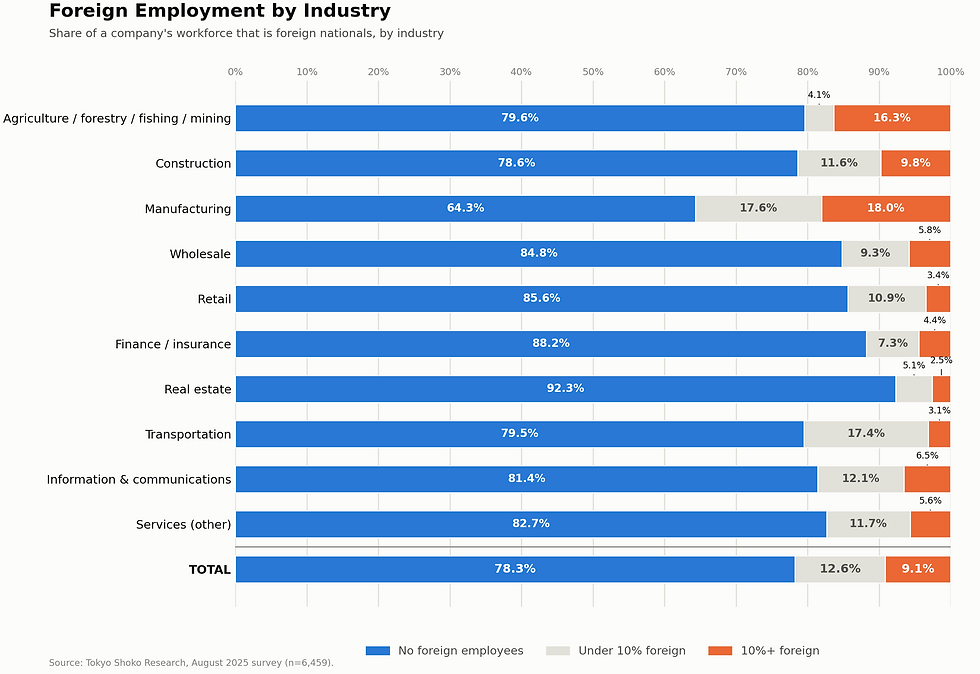
The picture looks different in a handful of industries where foreign labor has become a meaningful share of the workforce. The survey found that 18.0% of manufacturing companies, 16.3% of agriculture/forestry/fishery companies, and 9.7% of construction companies now have a workforce that's at least 10% foreign nationals — well above the cross-industry norm.
Among companies that already employ foreign workers, 53.4% said they'd increased that headcount over the past three years, suggesting the industries that have started relying on foreign labor are leaning into it rather than pulling back.
Looking at manufacturing specifically, 17.6% of manufacturers (282 of 1,598) reported a foreign workforce share just under 10%, and another 18.0% (288 of 1,598) were already at 10% or above — foreign hiring is relatively advanced in this industry. By contrast, the industries reporting the highest share of companies with zero foreign employees were real estate, at 92.3% (217 of 235 companies), followed by finance/insurance at 88.2% (60 of 68) and retail at 85.6% (274 of 320).
On the "10% or more" ranking across all industries, manufacturing again led at 18.0%, followed by agriculture/forestry/fishing/mining at 16.3% (8 of 49 companies) and construction at 9.7% (91 of 931) — a pattern showing that industries with more acute labor shortages and higher demand for technical skills tend to be more dependent on foreign workers. Real estate, finance/insurance, and retail sat at the opposite end at just 2.5% (6 companies), 4.4% (3 companies), and 3.4% (11 companies) respectively, suggesting that client-facing sales work and professional licensing requirements may be real barriers to foreign hiring in these sectors.
Hiring plans keep pointing the same direction
Looking three years ahead, 21.8% of all surveyed companies said they expect to increase foreign worker hiring. By industry, the appetite is clearly concentrated in physically demanding, labor-constrained sectors: manufacturing leads at 27.5% (408 of 1,480 companies), followed by transportation at 25.8% (59 of 228) and construction at 24.2% (204 of 840).
The reason employers give is almost unanimous. Asked why they hire foreign workers, 75.0% of companies (1,028 of 1,370) cited "addressing labor shortages" as the top reason — rising to 76.8% (933 of 1,214) among SMEs specifically. This isn't a story about cost-cutting or diversity initiatives; it's a story about employers who can't fill positions any other way.
What tighter immigration rules would mean for these companies
The survey also asked employers to look at the policy question directly: what happens to their business if the government restricts the acceptance of foreign workers? Overall, 52.6% of companies said they expect a negative impact on business performance. Among SMEs specifically, 13.7% (169 of 1,227) said the impact would be a "significant negative" — not a minor inconvenience, but a real threat to operations.

Why this matters right now
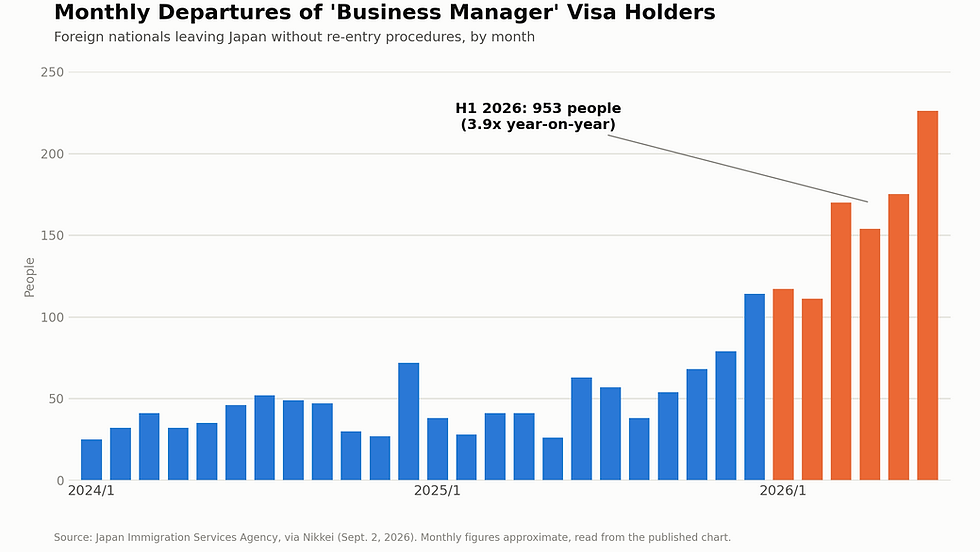
This survey predates the sharpest recent moves in Japanese immigration policy — the October 2025 tightening of "Business Manager" visa requirements and the October 2026 residency-fee hikes we've covered on this blog both came after this data was collected. But it helps explain the stakes underneath those policy changes: a meaningful slice of Japan's manufacturing, agriculture, and construction sectors already say they can't run without foreign labor, and more than half of employers overall expect tighter rules to hurt their business. Immigration policy in Japan isn't playing out in the abstract — it's landing directly on companies that say they have no other way to fill the jobs they have open.
Survey data: Tokyo Shoko Research (August 2025 survey, n=6,459).
Comments