
"Business Manager" Visa Holders: Departures From Japan Up 3.9-Fold in H1, as Capital and Other Residency Requirements Tighten

Based on reporting by Nikkei (Nihon Keizai Shimbun), published September 2, 2026

Foreign nationals who had been running companies and restaurants in Japan under the country's "Business Manager" residency status are departing at a sharply accelerated rate — a trend that appears directly tied to a tightening of visa requirements late last year.
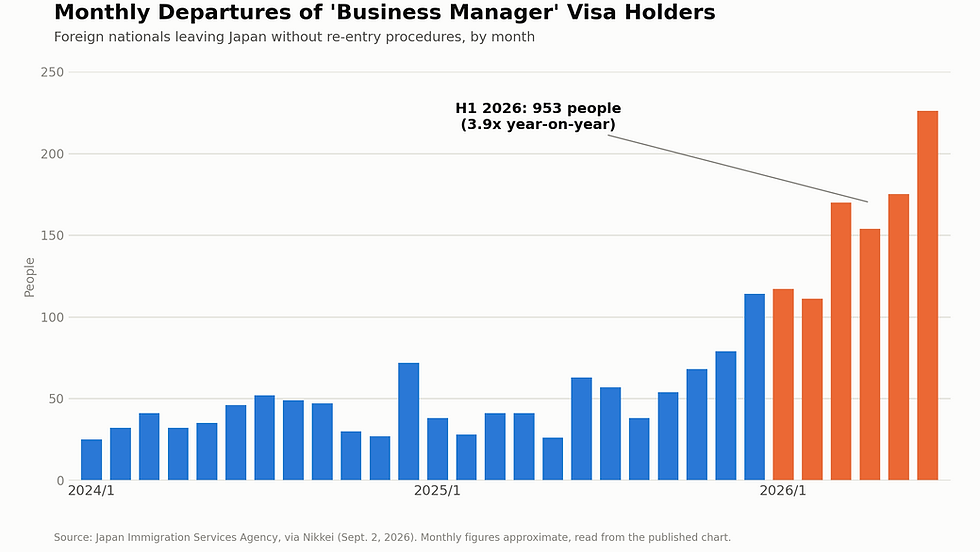
Nikkei's analysis of Immigration Services Agency statistics found that 953 people holding Business Manager status left Japan in the first half of 2026, 3.9 times the number over the same period a year earlier. The increase is believed to stem from stricter residency screening the agency introduced starting in autumn 2025.
From a few dozen a month to over 200
Nikkei's analysis focused on people who left Japan without completing the procedures required to re-enter — effectively, exits without an intention to return. Through autumn 2025, that number ran at just a few dozen people per month. It jumped to 114 in December 2025, and has held in the range of roughly 100 to 200-plus people per month through June 2026.
What changed: capital requirements six times higher
The Immigration Services Agency revised its ministerial ordinance in October 2025, substantially raising the bar for qualifying for Business Manager status. The minimum capital requirement for a corporation jumped from 500,000 yen to 30 million yen — a sixfold increase. The revision also newly required at least three years of management experience or a master's degree or higher, the employment of full-time staff, and a certain level of Japanese-language proficiency.
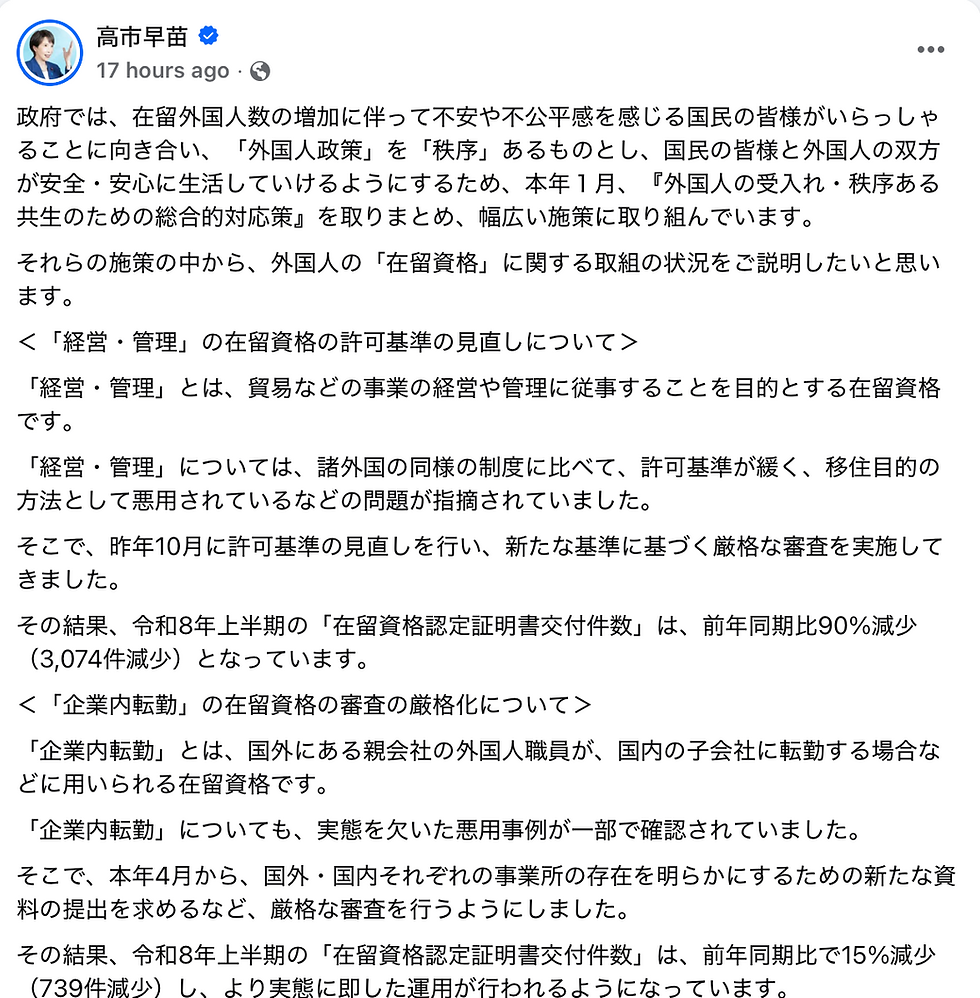
The backdrop: the number of foreign residents holding Business Manager status reached 46,781 at the end of 2025, 1.7 times what it was five years earlier. Justice Minister Hiroshi Hiraguchi, addressing the Upper House Judicial Affairs Committee in June, explained the reasoning behind the crackdown: "The approval criteria were more lenient than comparable systems in other countries, and there were reports of the status being misused as a backdoor route to relocating to Japan. In some cases, residency screening found that a business had no real substance behind it."
The agency says that until October 2028 — three years after the new rule took effect — it will still allow stay-period renewals for people who don't yet meet the new standard, and that even after that date, approval may still be possible if there's a realistic prospect of meeting the criteria eventually. Even so, there are reports that scrutiny of whether a business is genuinely operating, separate from the new numerical standard, has also become tougher in practice.
The agency had already disclosed that applications in the five months following the tightening fell roughly 96% compared with the five months before it. The new departure figures show that the impact isn't limited to prospective applicants — it's now visibly reaching foreign nationals who were already running businesses in Japan.
Most small businesses couldn't meet the new bar
The new 30-million-yen capital threshold is a high one by the standards of Japan's business landscape. According to Tokyo Shoko Research, of the 143,367 corporations established in Japan in 2024 (not counting sole proprietorships), only 1,491 — about 1% — were capitalized at 30 million yen or more.
Kenji Goto, head of that firm's information department, said the standard is likely out of reach for most small operators: "It's difficult for small businesses to meet the new standard. If foreign business owners end up closing shop, the impact will spread to the Japanese companies that supplied their raw materials or leased them commercial real estate."
Data source: Japan Immigration Services Agency, via Nikkei.
Comments