
Permanent Residency Can Now Be Revoked — New Guideline Sets Three Triggers, Effective April 2027

Based on the Immigration Services Agency of Japan's guideline "永住者の在留資格の取消しに関するガイドライン" ("Guideline on the Revocation of 'Permanent Resident' Status of Residence"), published on the Ministry of Justice website (source)
Permanent residency in Japan has always been described as the most stable status a foreign national can hold — no restrictions on activity, no fixed period of stay. That's precisely why the Immigration Services Agency says it now needs a formal mechanism to take it away from people who stop meeting the bar. A new guideline, released under the 2024 (Reiwa 6) amendment to the Immigration Control and Refugee Recognition Act, lays out exactly when and how that can happen.

Why this guideline exists
The guideline's own framing is blunt: continuing to let a small number of "problematic" permanent residents keep their status, when their actual conduct no longer meets the standards that earned them that status in the first place, creates public anxiety and a sense of unfairness — and runs against the goal of an "orderly" society where Japanese citizens and foreign residents coexist safely. To address that gap, the 2024 amendment added two new items — Article 22-4, Paragraph 1, Items 8 and 9 — to the law's existing list of grounds for revoking a residence status, specifically targeting permanent residents who fall out of compliance after the fact.
The three grounds for revocation
1. Failing to meet basic obligations under the Immigration Control Act. This covers things like failing to carry or present a residence card, or failing to notify authorities of required changes, without a "justifiable reason" — the guideline specifically carves out exceptions for circumstances like illness or disaster.
2. Deliberately refusing to pay taxes or social insurance premiums. The guideline is careful to define this narrowly: it has to be intentional ("故意に") non-payment that demonstrates the person has no intention of ever paying — not simply falling behind because of job loss, a medical emergency, or a domestic violence situation. "公租" (public taxes) covers income tax, resident tax, corporate tax, and fixed-asset tax; "公課" (public charges) covers health insurance premiums (national health insurance, employee health insurance) and pension premiums (national pension, employees' pension insurance). Hardship-driven non-payment is explicitly meant to be excluded from this ground.
3. Criminal conviction. A conviction resulting in imprisonment for specified offenses — the guideline names examples including theft, fraud, and causing death through dangerous driving — under statutes defined in the law.
Not automatic deportation — but not guaranteed to stay, either
Importantly, a finding under one of these three grounds doesn't mean automatic removal from Japan. The Minister of Justice has discretion to instead change the person's status to "Long-Term Resident" (定住者) or another appropriate status, allowing them to remain in Japan — unless continuing to reside in Japan is judged inappropriate, in which case the standard process toward deportation would apply.
How violations come to light
The guideline also describes a reporting channel: government officials who become aware of facts suggesting one of these grounds may apply can report them to immigration authorities. This reporting is voluntary on the officials' part and reporting a suspicion does not, by itself, trigger revocation — each case is still meant to be assessed individually, and the guideline emphasizes caution given the settled interests of long-term residents.
When this actually takes effect
These revocation grounds come from Reiwa 6 Act No. 60, promulgated in June 2024. Per the Ministry of Justice's own implementation schedule, most of that law's provisions — including the permanent residency changes — take effect on April 1, 2027. In other words, this guideline is Japan's advance notice of a rule that isn't live yet, giving permanent residents, employers, and immigration practitioners roughly a year and a half of lead time before it applies.
How this fits with what we've covered so far
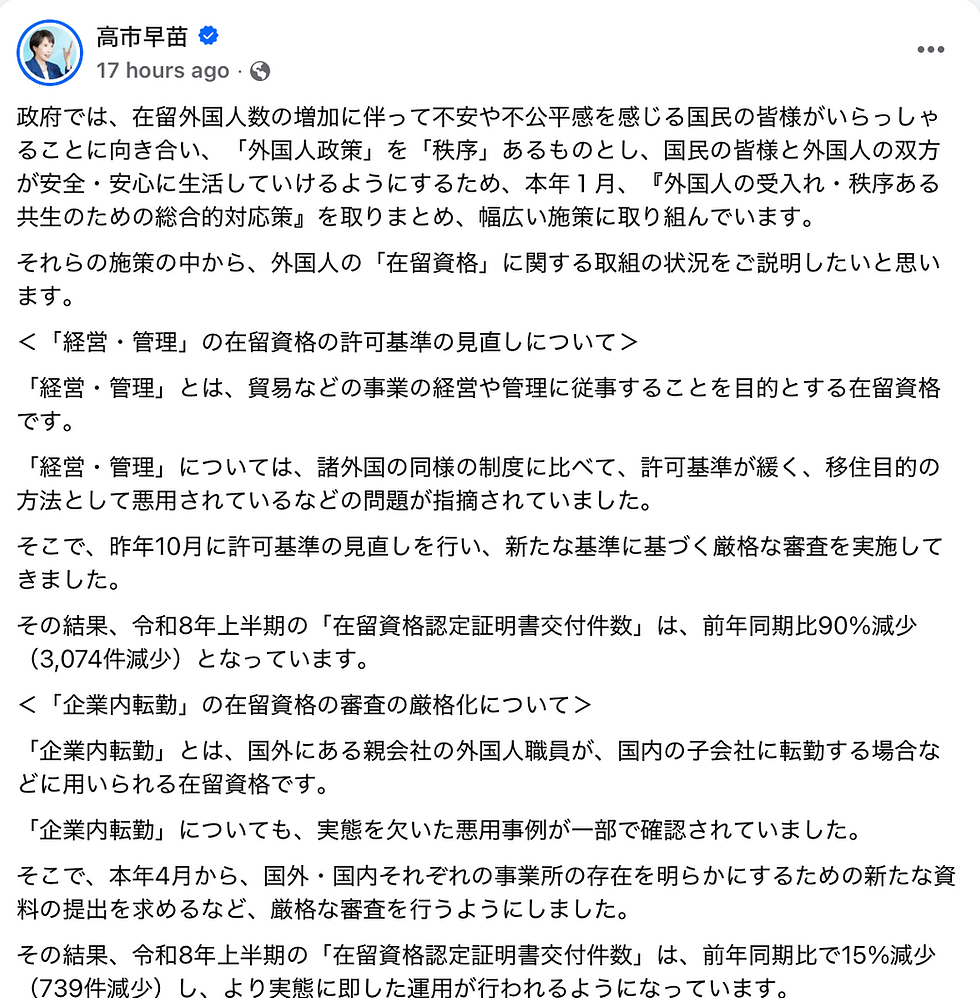
This is a different track from the permanent residency permission guideline we covered from Prime Minister Takaichi's September 27 Facebook post — that one governs who qualifies for permanent residency in the first place (income thresholds, Japanese-language ability, and so on) and was set to be revised October 1, 2026. This guideline instead governs revocation: the grounds for taking permanent residency away from someone who already has it. Together, they're two halves of the same policy push — tightening both the front door and the back door of Japan's most stable residence status — and both trace back to the government's broader "Comprehensive Response Package for the Acceptance of Foreign Nationals and Orderly Coexistence" from earlier this year.

Comments