
Takaichi to Decide by March Whether Japan Caps Its Foreign Resident Population — Populist Party Pushes for Hard Numbers

Based on reporting from Nikkei, "高市首相、人口予測踏まえ外国人受け入れ規制 参政は上限導入要求" (“PM Takaichi: Foreign Resident Acceptance Rules Based on Population Projections; Sanseito Demands a Cap”), published October 9, 2026
Prime Minister Sanae Takaichi told the Diet this week that her government will decide, by the end of the current fiscal year, whether to cap the number of foreign residents in Japan — a decision she says will be based on the country’s own population projections rather than on a fixed political target.
What the Prime Minister actually said
Speaking in the House of Councillors on October 9 during representative questions, Takaichi said the government would “present a future simulation of population dynamics and the overall picture of our response.” She tied this directly to Japan’s shrinking and aging population, calling for a rebuilding of the economy and society alongside countermeasures to the falling birthrate.
The government plans to finalize a comprehensive population strategy by the end of the year, built on the premise that reversing population growth is unlikely even with stronger childbirth support. That strategy will be worked out together with a separate “basic policy” on accepting foreign residents, due by the end of March 2027. In other words, the cap decision isn’t happening in isolation — it’s being folded into a broader reckoning with Japan’s demographic trajectory.
The numbers behind that trajectory are stark. Japan’s population fell below 120 million in January 2026 for the first time in 42 years. The National Institute of Population and Social Security Research’s median projection has the total population falling to around 87 million by 2070.

The labor shortage cuts the other way
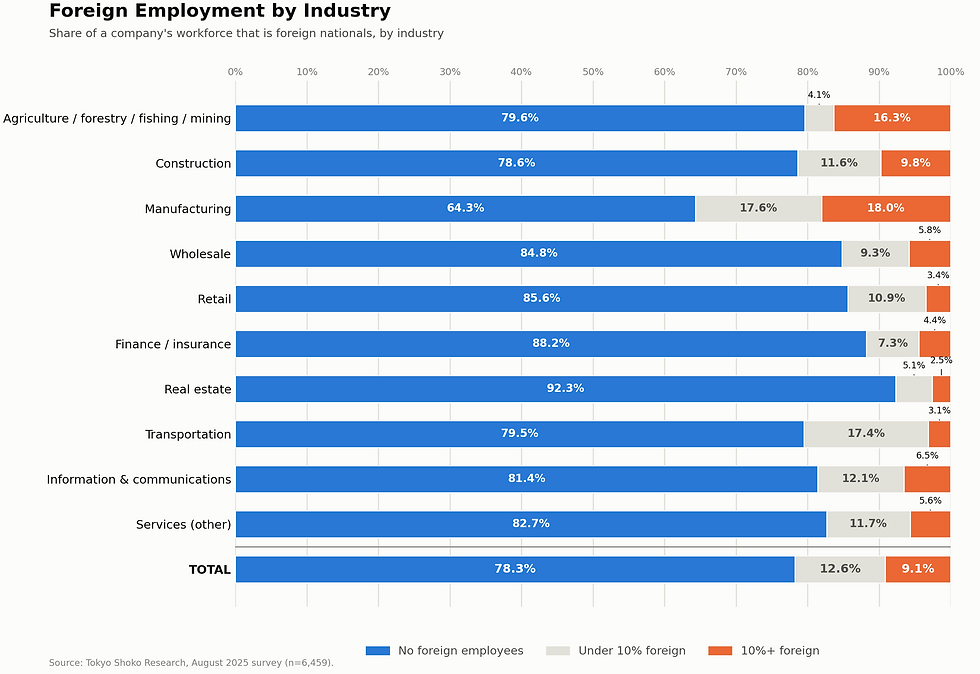
Justice Minister Takashi Yamashita, at a press conference in September, put the tension plainly: “There are fields that need foreign workers given the labor shortage. It’s a fact that Japan is becoming that kind of society.” Construction, manufacturing, and services are named as the sectors where the shortage is most acute, and both the business community and local governments have been pushing for greater use of foreign labor. A shrinking labor force is a long-term drag on economic strength, and the article notes real limits to how much further Japan can lean on expanding elderly employment or AI-driven productivity gains to make up the difference.
Set against that is the opposite worry — that accepting foreign residents too quickly invites social disruption, a concern that’s been gaining political traction.
Sanseito wants a number. The government doesn’t have one yet.
The sharpest moment in this exchange came from Sohei Kamiya, head of the populist Sanseito party, who pressed Takaichi directly on whether the government should set concrete numerical targets or caps — on the annual net inflow of foreign nationals, the total foreign resident population, or the foreign share of Japan’s overall population.
Right now, none of that exists as a matter of law. Caps apply only to specific residence statuses — the “Specified Skilled Worker (i)” category for certain technical fields is one example — but there is no statute capping the total number of foreign residents in Japan. As of the end of 2025, that total stood at 4.12 million.
The scale of recent growth is a big part of why this question is now live. In 2023, the national research institute projected that foreign nationals could exceed 10% of Japan’s total population by 2070. But the foreign population has been growing by more than 300,000 people a year recently — well ahead of the pace that 2023 projection assumed. In July 2025, then-Justice Minister Keisuke Suzuki acknowledged that the timeline for hitting that 10% mark “could come sooner” than expected.

Japan’s foreign resident population has roughly doubled since 2012, and its share of the overall population has been climbing faster in the last few years than in the decade before. The 2070 figures reflect the National Institute of Population and Social Security Research’s projection that foreign nationals could exceed 10% of a shrinking Japanese population by then.
That same month’s Upper House election saw Sanseito surge on a “Japanese First” platform, and a Nikkei opinion poll around that time found the public roughly evenly split between those who think foreign acceptance should expand and those who think it shouldn’t. The ruling coalition’s partner party, Nippon Ishin no Kai (Japan Innovation Party), went further in January, formally proposing that the Prime Minister use visa issuance as a lever to manage population size and calling for consideration of a cap on the foreign share of the total population.
Why the Takaichi government has resisted a hard cap — so far
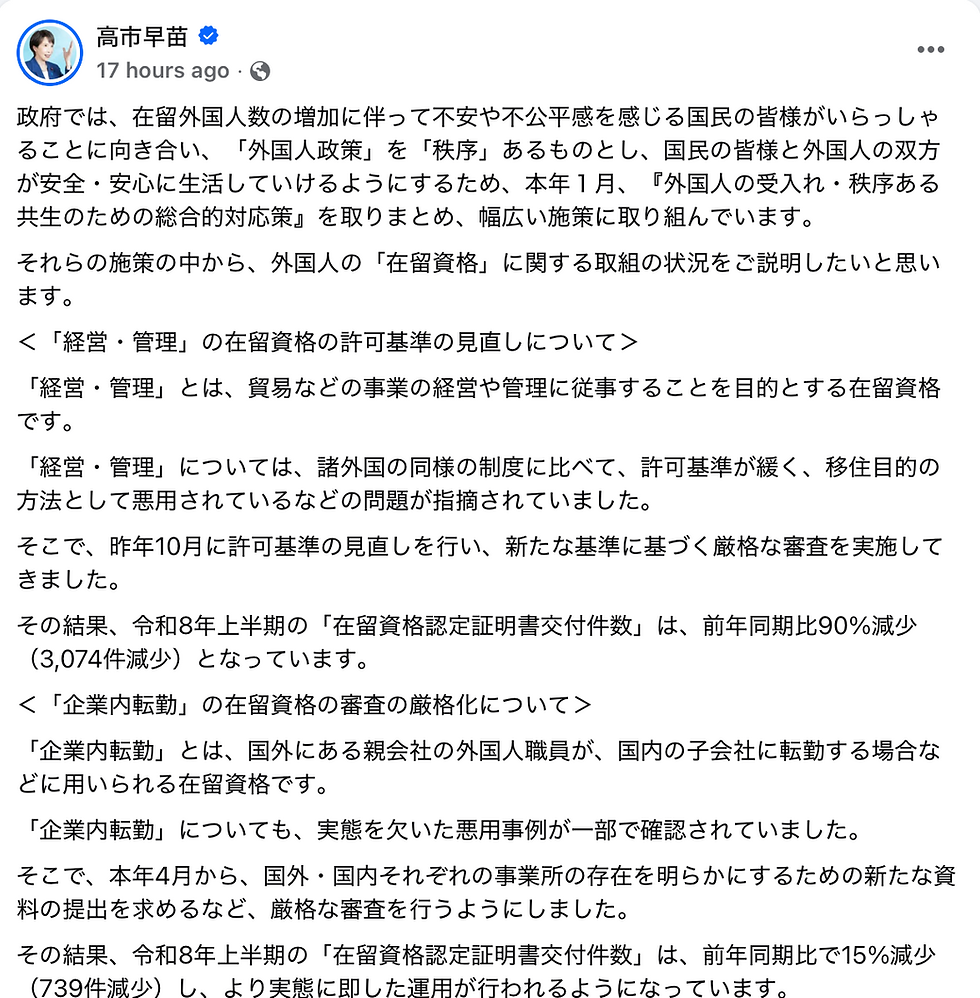
Despite that pressure from both inside and outside the coalition, the Takaichi government has so far avoided setting any cap or numerical target, instead tightening the requirements and screening for individual residence statuses — the kind of status-by-status moves we’ve covered on this blog, from the “Business Manager” visa crackdown to stricter “Engineer/Humanities/International Services” screening to the new permanent-residency revocation guideline.
An Immigration Services Agency official explained the logic to Nikkei: setting an overall cap is less useful than optimizing each residence status individually, because status-by-status adjustment allows the government to respond flexibly as economic and social conditions change. It’s a deliberate choice to keep the policy lever granular rather than blunt.
The coordination problem
The article points to a structural issue underneath all of this: as foreign acceptance keeps expanding, ad hoc, status-by-status responses are reaching their limits, and the relevant policies are split across the Ministry of Justice, the education ministry (MEXT), and the health and labor ministry (MHLW). Without a shared vision for what Japanese society is supposed to look like, these scattered policies risk pulling in different directions.
MEXT, for its part, is responsible for giving foreign residents access to Japanese-language learning. The government is creating programs covering Japanese language and the rules of daily life, to be phased in starting in fiscal year 2028 — meaning the practical groundwork for integration is, by the article’s own framing, only now starting to get underway in earnest. At the local level, some municipalities are already working to prevent a split between long-time residents and newcomers and to actively support coexistence, with an eye toward making Japan a country that skilled foreign workers actually choose to move to.
Why this matters
This is the clearest signal yet that Japan’s immigration debate is shifting from a series of individual visa-category tightenings — which is where nearly all of the policy action has been so far — toward a question about an actual ceiling on how many foreign residents the country will accept. Whatever the government decides by next March will set the frame for everything else we’ve been tracking on this blog, from residency fees to visa screening to permanent residency rules. It’s also, for the first time in this policy area, being driven as much by raw demographic math — a population that’s already shrunk by millions and is projected to keep shrinking for decades — as by anxiety about the pace of change itself.
Source: Nikkei (日本経済新聞), October 9, 2026 (source: https://www.nikkei.com/article/DGXZQOUA082E70Y6A001C2000000/)

Comments